Archive for May, 2007

Avantex – International Forum for Innovative Apparel Textiles

Tuesday, May 22nd, 2007

Marion will present EduWear at this well known exhibition. A poster has been prepared, see beneath.

Date: 12 – 14 June 2007
Place Frankfurt am Main (Germany)

Check the Avantex homepage at
http://avantex.messefrankfurt.com/global/en/home.html

Following subjects are addressed:

“The Future of the European Textile and Apparel Industry”
This session coorganised by EURATEX, its Working Group Technical Textiles and Messe Frankfurt discusses trends, strategies and visions of that industry.

“4th International Avantex-Symposium”
The symposium offers a wide range of interesting and innovative lectures and presentations for suppliers, users and experts …

“Avantex and Techtextile”

Ideas for Developing Materials & Designing Workshops

Monday, May 21st, 2007

To develop an awareness among teachers and young people about what could be possible in the future and to stimulate discussion about smart textiles etc. I suggest using sections of this programme that has been developed by the Discovery channel.
Source:
http://video.google.com/videoplay?docid=1537644238897941086

This website which has been developed to discuss the theme 2057 could also be used www.discovery.com/2057

Sportswear

T-Shirt
heart rate monitor built in to clothing
sensors which measure / keep track of certain movements
e.g. switches / touch sensors at side of garment which count number of star jumps as both have to be activated to count a correctly completed jump
similar approach with sensor in back of T-shirt for measuring sit-ups

Socks
keep track of distance covered in particular time period
measure pace – count steps (similar to a pedometer built into sock)
use Excel to graph the input / develop their own formulae for using input information e.g. length of pace x number of steps; distance covered each day, cumulative distance over a week etc.
keep track of this over a period of time / personal targets

Measure Heart rate / Recovery time (Can something be developed that could be integrated into clothing to capture these metrics?)

Track your physical activity over a given period of time

Posture – is there something that could be built into clothing to monitor this?

Messages that appear on your clothing – positive feedback about your physical well being / completion of targets set by child (regular exercise becoming part of their day / feedback/ motivation built into clothing; targets adjusted as time goes on).

Fabric that reacts to heat might be a possibility to use for this.

Fashion Accessories – Bracelets

As well as clothing we wear fabric could be used to design Bracelets / necklaces and other fashion accessories. These accessories are smaller and more versatile and within the capabilities of children to make. Children of this age would also be motivated to design quite a number of them if the materials allowed for a number of functions. The aesthetic qualities of the materials and the design of the accessory would also be important as children would be interested in creating something that was individualistic and “looked cool”.

e.g. Measuring pulse rate these could give feedback (lights light up according to particular targets being reached or fabric changes colour )

Circuit training – different activities which are monitored. The bracelet could have different sections which activate as each part of the circuit training is completed.
Or maybe different parts of the bracelet react to different environmental conditions.

Hats could be another accessory which could be designed (reacting to light conditions)

Espionage Theme

– secret messages / spies / undercover agents

Making Toys / Games

Designing Hand Puppets (the Glove could be used for this)
Characters in a story – that react to each other
Combine the characters in a particular way then something happens ( a tune is played / a light sequence occurs)
Or some switch or environmental conditions triggers the reaction (hot/cold; light or dark; switch is on /off).

The Glove could also be used for games which the children can invent (they will be much more creative than I am / rules of engagement as it were then are develop as the game develops)
e.g. during the game each child has to make contact with every other participant or a given number of participants in a particular order. Depending on the interaction then there is a particular reaction on the glove (colour change / light sequence / sound made etc). When the children get more experience they could perhaps design and program the glove for a particular reaction to happen when you interact with someone who has the necessary attribute to trigger the preset action. (e.g. If I have designed my glove with a fabric switch / touch sensor inside so that when it is turned on by someone shaking my hand a light is turned on. If pressure can be measured then maybe depending on the intensity of the handshake the response varies – more lights are turned on / sound that occurs is longer)

e.g. dance sequences could also be built up in the same way as games are developed.

Making fabric balls (roll – measure distance; if they collide there is a reaction)
Fabric skittles (tilt sensor – calculates scores when skittles are knocked over)

(by Deirdre)

Ideas around the Body Lab – The Glove

Wednesday, May 16th, 2007

Further ideas referring to the idea of a body lab where children get the opportunity to experiment with different sensors and actuators which are connected to the movements of their body have led to a glove:

The idea is that it is empty at the beginning so the purpose is open still. Later different sorts of sensors or actuators can be implemented according to children’s decisions.

Several gloves have been produced so far:

Yard Ware and Smart Textile Connectors

Wednesday, May 16th, 2007

In order to improve the connection between textiles and hardware, the conductive marterial is woven into the fabric so that it can be cut along determined distances:

A closer look reveals the conductive threads which are woven into the fabric:

New Software version

Thursday, May 10th, 2007

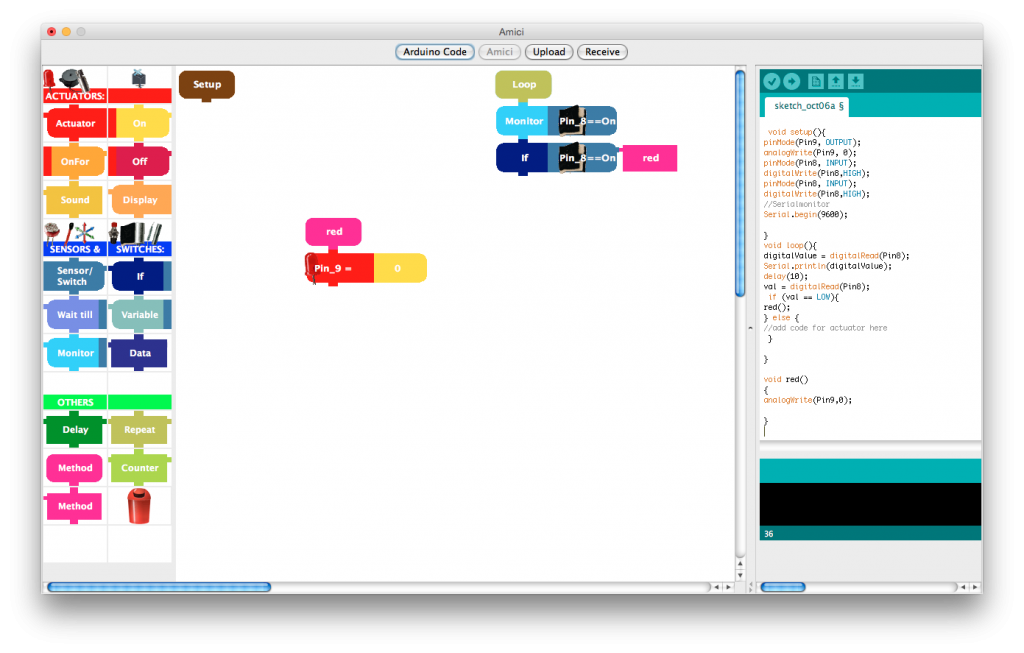
After the workshop we had a lot of issues to work on. Now we can release a new version for Mac PPC, Mac Intel and Windows. You can download the software and type in a terminal sh run.sh or double the run.bat on Windows.

It will run the German version. To get the English one you have to go to work/lib and rename probs.properties.eng to probs.propertie.

The errors we fixed are the following:

Show Values of Variable on the piece

Scrollbars not displayed after resize

Resize does not work properly

Tool tips only work after new block is on the grid

pin 0 and 1 are missing in some dialog

Sometimes blocks disappear while moving

Save xml format in web

Kit sketches

Tuesday, May 8th, 2007

The basic kit for beginners to learn about circuits has a databus with gaps and is connected to a power source. As the circuit is not closed the actuator patch (here an LED) won’t work.

Now the learners can close the gap and make the led light up by using various textile techniques (in the example sewing and glueing).

Or by adding switches to the circuit.

The circuit then can be attached to a piece of cloth or bag or anything else.

The more advanced learners will program a microcontroller that is connected to the bus in order to use more advanced sensor e.g. the stretch sensor.

The learner can either attach the sensor and actuators directly to the patch or put them somewhere else on a piece of close by e.g. using conductive yarn in between.

Schematics

Tuesday, May 8th, 2007

Before I leave next week for a 3 weeks holiday I made some Eagle schematics board layouts that I will etch when I am back.

One is a little board for external power supplies e.g. for powering the thermochromic material.


Another one is a basic board layout in case we decide to use the ATmega8 directly with an ISP programmer instead of using the bootloader.

Attaching controllers to fabric

Monday, May 7th, 2007

Still we have to attach controllers to fabric in a reliable and nice-looking connection. A very nice technique by Leah Buechley (http://www.cs.colorado.edu/~buechley/engineering/fabric_PCB.html) who irons laser-cut fabric pcbs on fabric exists. Unfortunately we do not have a laser cutter. As we will stick (for this time) to regular etched pcbs we only have to connect the output pins to fabric so we can use a very quick and dirty variation. I partly cut out stripes stick the pins through from the other side and glue them together. Now I can sew to the textile databus.

EduWear Presentation at TZI-Info Day on 10th of May 2007

Friday, May 4th, 2007

The TZI Info day deals with new working and living environments with ICT and the demographical change. The audience is from economy and science and the idea is to bridge these through presentations and interviews. The TZI Info Day Program can be checked where the titles of the presentations and topics are partially in English.

The idea was to hold a presentation on the project and the first workshop…

as well as give an outlook of the future and what kind of settings we plan with the construction kit, such as marginalized groups, migration groups and intergenerational learning groups:

At a later stage we had the opportunity to show examples and explain these to the audience:

We showed different examples, for instance the necklace with a programmed order of LEDs glowing and a shirt with a tilt sensor on the sleeve:

We also explained the function of the data bus and its role in circuits as well as the idea of a two-level kit, i.e. for introductory purposes and advance level learning goals:

While answering questions contacts have been made because of a more informal setting. This way the presenters and the audience could play around with the artefacts…

…and discuss the background of the project:

Using Arduino with an external programmer

Wednesday, May 2nd, 2007

As the bootloader solution of Arduino proved as problematic with young children I tested several different solutions. One is to use a cheap serial programmer to program Arduino via ISP programming. Unfortunatly Arduino relies on uisp that does not support newer version of the sdk500 firmware or usb programmer that is why I could not use the Atmel original hadrware. I used an avr910 and changed the preferences.txt and set upload.erase=true, upload.verify=true and serial.download_rate=115200 as written on the Arduino website. Also upload.programmer had to be set to avr910. A crucial point is (especially when using an usb-serial adapter) to set the Comport number between 1 and 4. Using the external programmer we could simplify the board further.

Arduino uses the 6-pin ISP while the programmer (if you buy a ready-made one) uses 10-pin – you need an adapter.